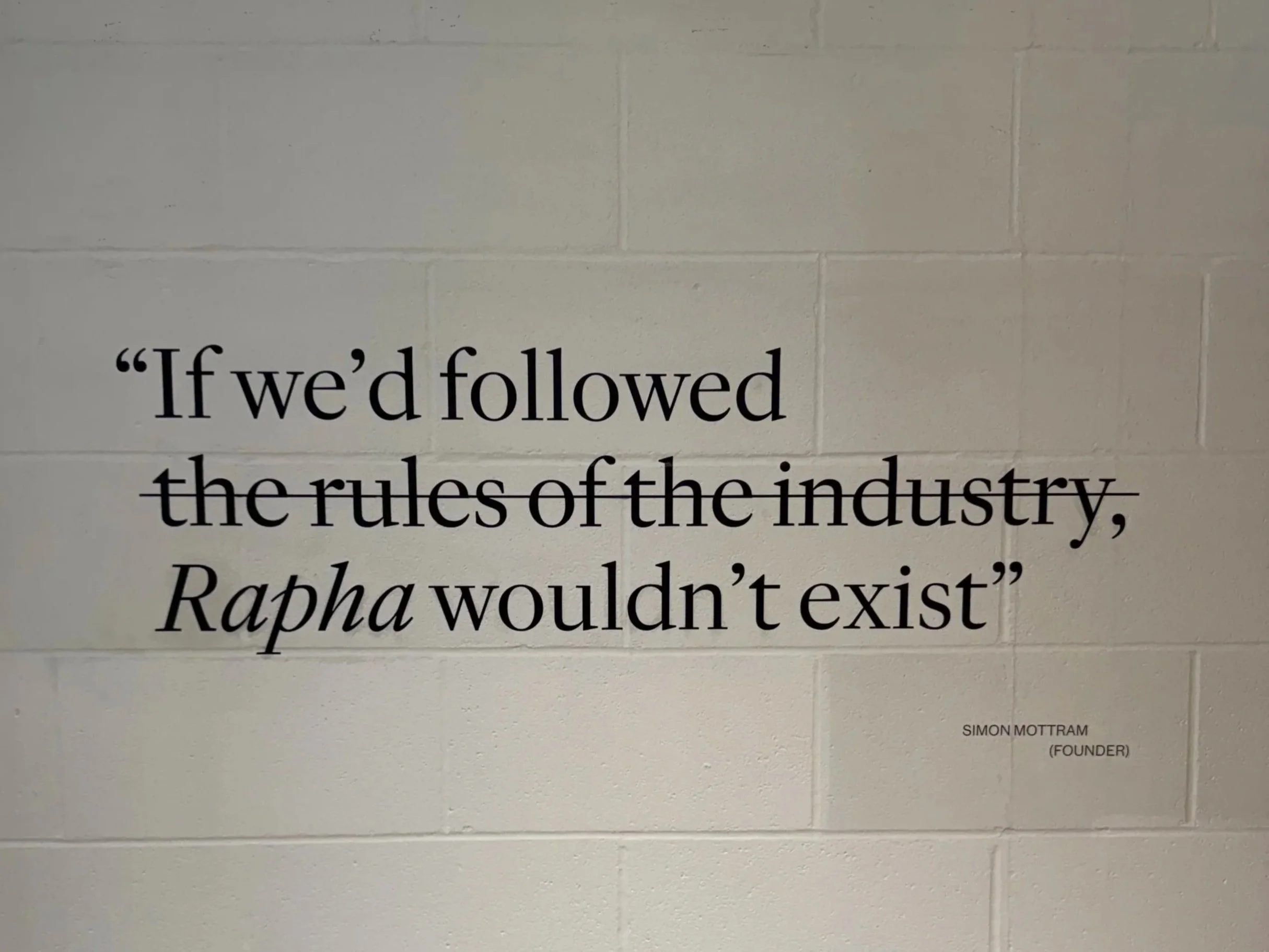
Image: Rapha London, May 2026
Connecting Dots is the monthly newsletter for innovation leaders by Brett Macfarlane.
◎⁃◎
Leadership is the Last Line of Defence Against AI Mediocrity
How caring about quality costs little and returns much.
Did you work your way through university, into your career, and up to your current role so you could watch mediocre work become normal? Few signed up for that—and yet it’s a battle I hear more leaders fighting every week.
The primary task of leadership is to drive change with others. The kind of change you choose will either raise or lower the quality of what your firm, department, or team produces. One of your most important responsibilities is to identify—and clearly state—when something isn’t good enough and support ways to make it better.
For innovation leaders, this is especially consequential. The standards you defend today become the organization’s default tomorrow. Every “good enough” you approve in a pilot, prototype, or early product quietly writes the rulebook for what the rest of the company will treat as normal.
It’s easy to let outputs, processes, products, or services go out the door that don’t meet that bar. “Not good enough” doesn’t always mean catastrophically bad—like the Starbucks South Korea promotion that leaned on a painful historical reference because AI suggested it. That was an obvious failure of critical thinking at multiple levels.
When “good enough” Becomes Average
More often, “not good enough” simply looks like average—which is exactly where AI excels. Most professionals with reasonable experience can sense when a brief, a proposal, a strategy deck, or a specialist’s output is competent but unremarkable.
In the age of AI and endless hot takes and instant analysis, many leaders have quietly forgotten that their job is to be the standard-bearer of quality. If you accept average as good enough, that becomes your standard. And performance, results, ethics, differentiation, profit, resilience, defensibility, trust, brand loyalty, productivity—every metric we track—is driven, over time, by quality.
This isn’t only about outputs that fall short. A high standard also includes pace and means of delivery. Endless perfectionism isn’t excellence; it’s a leader avoiding the hard conversations that would let the work reach the people who need it.
What it Feels Like to Set the Standard—and the Future
You know you’re having a real conversation about “good enough” when opinions diverge. This is where AI mediocrity gets subtle. It’s not just flattering affirmation from your favourite tools; it’s also the presence of both supportive and critical AI-generated perspectives—a buffet of averageness in every flavour.
Choice paralysis is well understood in the science of shopping. It’s now seeping into executive decision-making. We’ve exponentially increased the volume of opinions to choose from—automated tools, consultants briefing different executives, internal experts and advisors—making decisions harder and often lowering the quality of outcomes.
Remember a foundational principle of disruptive technology, in Clayton Christensen’s sense: it introduces a dramatically lower-cost, lower-quality version of an existing product, enabling new use cases. The problem arises when that lower-quality output is used as a substitute for high-quality work. As with mini-mill rebar in place of structural steel: if you use low-grade material where high-grade is required, the result will not hold.
The bad news: it’s uncomfortable to tell people their work isn’t good enough—especially now, when anxiety is high, teams are in flux, and trust is contested. Hence the drift into generational blaming, crisis paralysis, or KPI dependencies as defences against the real work of fostering quality.
The good news: most people want to do good work. They want to learn and push beyond their comfort zones—when it’s done in a way that feels supported, with constructive discomfort. That doesn’t mean hard truths can’t be shared, or that everyone gets what they want. That’s not leadership. Nor is it effective followership. Quality comes from working alliances where every member is responsible and contributes to better outcomes within the scope and authority of their role.
Often it’s not more time but more cognitive work that leads to quality: caring about the art and craft that may be felt, if not seen, by the people using what you produce. That’s a deeply human process, still challenging even when generating adversaries or mediocre ideas has never been easier. The behaviour and organizational design remain stubbornly real. Consequently, many of you will report this period as some of the most intense of your careers.
Practices for Defending Quality
As the last line of defence against AI mediocrity, our responsibility as leaders is to build practices and muscles that create a shared commitment to quality. That includes:
Naming “good enough” explicitly for each piece of work: fit for purpose, on time, ethically sound, and distinguishably better than average.
Creating forums where divergent views are expected, and the leader’s role is to facilitate and reconcile to a clear direction, not to collect ever more opinions without decisions or operate in isolation.
Distinguishing between “needs more craft” and “needs more time,” and protecting the cognitive work that turns competent into excellent.
Using clear language about what’s getting in the way: outlook, empowerment, risk tolerance, autonomy, mindset—are these too high, too low, or misaligned?
These questions determine whether a team can collaboratively reach “good enough to ship” at a standard that makes both customers and peers proud. For innovation leaders, that work is doubly important: you’re not only guarding current quality, but you’re setting future standards for the organization.
The bar you hold in experiments, customer centricity, roadmaps, launches, and iterative learning, as much as meeting design, onboarding processes, and how reception greets guests, becomes the inherited standard for teams that will scale what you start.
◎⁃◎
Questions, reflections and feedback to info@brettmacfarlane.com