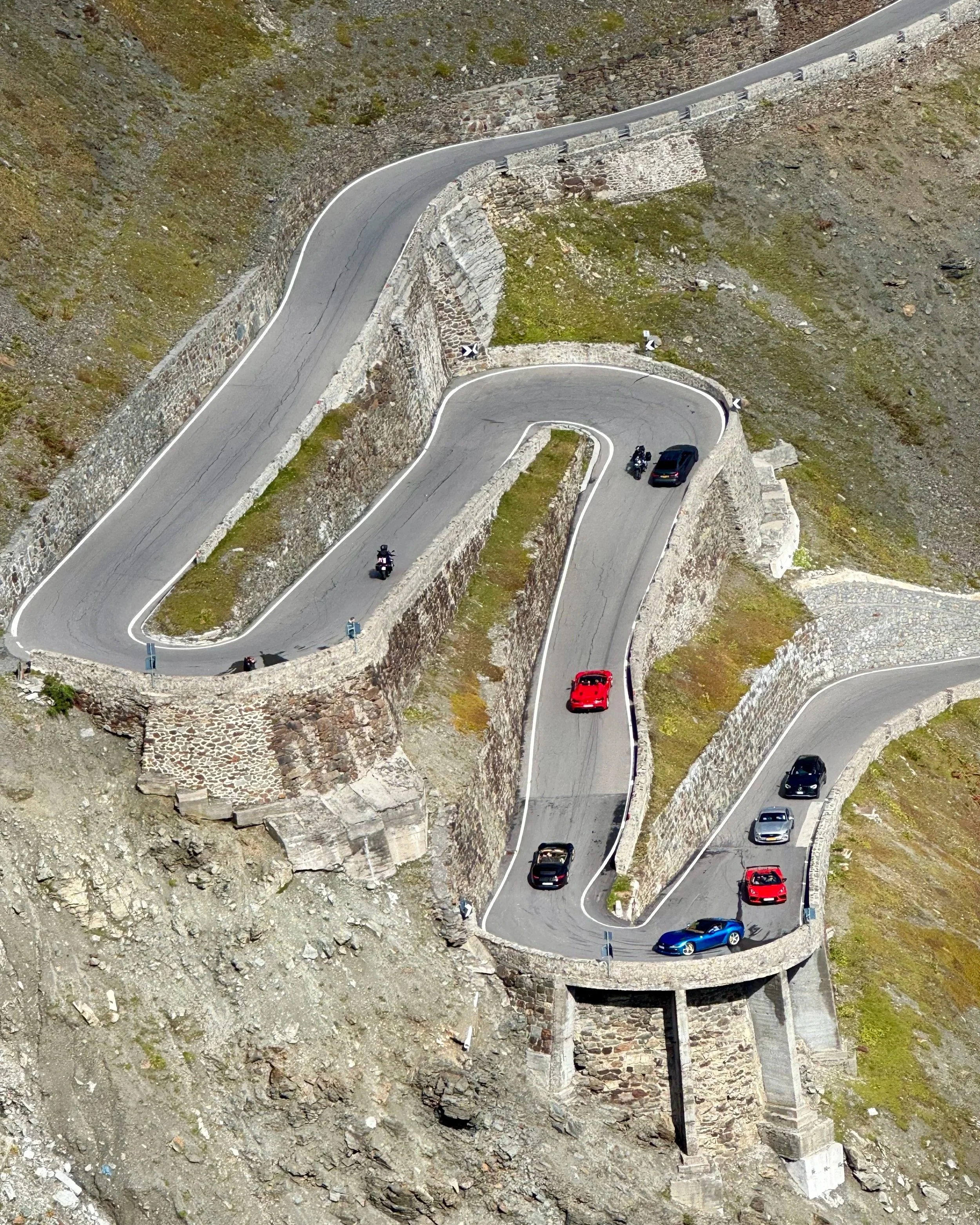
Image: Passo Stelvio, September 2026
Connecting Dots is a monthly newsletter about innovation leadership by Brett Macfarlane.
◎⁃◎
Navigating Innovation Turbulence: Old School, New Rules
Recently, I was asked to share remarks at a global symposium on the theme of “Turbulent Work Today”. The audience was psychoanalytic organizational researchers, L&D executives, and advisors—people who study and try to improve the behavioural systems of individuals and teams, often amid failures of collaboration, effectiveness or ethics
I chose this title to counter a common assumption: that we have lost certainty and need entirely new tools to navigate a dramatically different landscape. In fact, turbulence is the norm—and we have the tools. Hence my title “Old School, New Rules” (thanks to the Financial Times for the inspiration).
Five Superstorms of Turbulence at Work Today
What is new is that the environmental contexts in which work exists—organizations—are changing faster and becoming more complex. This hardly needs labouring. The father of economics, Adam Smith, thoroughly described it over three hundred years ago; psychoanalyst Freud then observed its human impacts in the era of mass mechanization; seminal scholar Schumpeter studied it as management professionalized; while in contemporary times, Clayton Christensen and many others have attempted to make sense of this accelerating phenomenon driven by technology whose roots extend across all cultures back to at least when humanity first harnessed fire.
People experience this constant change as turbulence: swirling, unstable, sometimes violent reactions in how we act and interact at work. Today, most workers feel this acceleration most acutely through algorithmic tools of varying sophistication— i.e. “AI”.
Step back, and five superstorms set the new rules leaders must address:
1. More emotional awareness means more emotional intensity
We have more language, frameworks, and permission to talk about emotions at work. At the same time, we expose people to more stimuli, feedback, and comparison. The result is not calmer workplaces, but more intense emotional landscapes.
People are more aware of their anxiety, envy, shame, and ambition—and more willing to express them. That can be liberating, authentic, and trust-building. It can also be overwhelming, irrelevant, and isolating, especially without a container for it or training amongst leaders on how to metabolize or guide emotionality towards the primary task of the organization and team. For many, it emotionally feels like everything, everywhere, all the time.
Emoitonal intensity, is emotionally exhausting.
2. More interpersonal connectedness means greater interpersonal conflict
Slack, Teams, email, video calls, shared docs, WhatsApp groups: we are more connected than ever. But as we flatten structures and increase collaboration, we increase the surface area for conflict.
Boundaries, authority, roles, and tasks must be renegotiated in real time, in visible channels. Informal chats that once dissipated into the air, or happened one-to-one, are now documented, searchable, many-to-many conversations. The water cooler is now a permanent, recorded, multi-threaded arena.
More connection, more conflict.
3. More delusions of determinism means more pseudo-certainty
Dashboards, forecasts, AI recommendations, KPIs, OKRs, risk models, best practices, ethics frameworks, and net promoter scores promise certainty. Yet many offer a facade of determinism over deeply probabilistic and emergent realities.
Leaders act as if the model is reality. They treat AI outputs as answers rather than predictions with confidence intervals. This creates pseudo-certainty: a false sense of control that breaks down the moment turbulence hits.
Data becomes god rather than a guide.
4. More dematerialization of work means less material satisfaction
Work is increasingly abstract: prompts, models, dashboards, meetings about meetings. The tangible artifacts of labour are less visible. People type, click, talk, and decide, but often cannot point to something they made.
The result is a quiet but persistent loss of satisfaction. The work is cognitively demanding and emotionally intense, yet strangely insubstantial. Whether in a community centre, national command office, or global organization, dematerialization gets in the way of satisfaction.
Dematerialization becomes detachment.
5. More disintermediation of relationships means less relational infrastructure
AI, automation, and platforms remove layers of intermediaries. That can increase efficiency—but it also erodes the relational infrastructure that once absorbed shocks: mentors, middle managers, guild-like professional communities, stable teams.
Alignment and adherence now take primacy over connectedness, communication, and comprehension—within, let alone between, sub-groups. People are more directly exposed to volatility, with fewer buffers. When turbulence hits, there is less capacity to absorb it without fracture or activating fault lines.
Bigger networks, weaker ties.
Dynamic Capabilities: Evolving Our Practice
As leaders driving innovation forward, we must face uncertainty and generate good-enough clarity about where we are going. I proposed four evolutions of our practice; here, in this article, I focus on one: moving from individual resilience to institutional dynamic capabilities.
Old school dynamic capabilities emerged from the last major industrial transition, in the 1980s and 1990s, as economies shifted rapidly from manufacturing to intangibles. Forging steel went from a two-week process to two hours in a year. Fast.
Dynamic capabilities are a simple yet profound capacity for an organization and its people to navigate the highly turbulent whitewater of uncertain times and markets. The recent focus on individual resilience matters—but if the organization does not develop dynamic capabilities, you simply have under-utilized resilient talent.
Instead of focusing only on individual coping, help organizations systemically build the capacity to sense, seize, and reconfigure in response to high-velocity market change. Researchers observed that “the most successful product development processes relied on limited routines for priority setting, a business vision that bounded possible products, and adherence to deadlines, but little else in the way of routines.”
That last part is profound in its simplicity, yet challenging for most organizations to tolerate in place of over-engineering routines for an illusion of certainty. Though, three dynamic capabilities stand out as practices that govern knowledge creation and distribution in service of new product and process development:
Generating new knowledge over seeking best practice or what others already know
Routines to learn routines—simple routines for priority setting and knowledge sharing
Strategic decision-making that selects for breadth of learning over narrow variation
One challenge for leaders is knowing when to shift from a low- to high-turbulence operating mode—and back again—whether across the organization or in functions and divisions at different phases of the market.
That is why it may be helpful to revisit old-school foundations for dealing with turbulence, adapted to today’s rules in your geography or segment. Be confident in what we know from the past, but not so complacent that we fail to create new knowledge for currents unique to today.
Concretely, to navigate turbulence while developing capabilities in practice:
Help leaders identify early warning signals: spikes in conflict, repeated last-minute changes, rising cynicism, missed accountability
Use one-to-one agents as accountability and feedback partners
Track sentiment and signal escalating leading indicators of team health
In many ways, this is the modern equivalent of walking the floor: getting the smell of the place, listening and hearing how the team or factory is functioning.
The goal is not to eliminate turbulence, but to increase the organization’s capacity to move through it without fracturing.
◎⁃◎
If you’re interested in the full remarks, or if my adaptation leaves points unclear, please request the full text or ask questions: info@brettmacfarlane.com